

Roberto Carlos rose from humble beginnings in Brazil to become one of the greatest left-backs in football history, achieving legendary status at Real Madrid and in the Seleção Brasileira.
Born on 10 April 1973 in Garça, São Paulo, Roberto Carlos da Silva Rocha grew up in modest circumstances, where football was both a passion and a pathway out of hardship. His journey began at União São João, a small club where his explosive pace and powerful left foot quickly caught attention.
By the age of 19, he was already a rising star in Brazil, earning a move to Palmeiras, where he won two league titles and formed a dazzling partnership with Rivaldo.

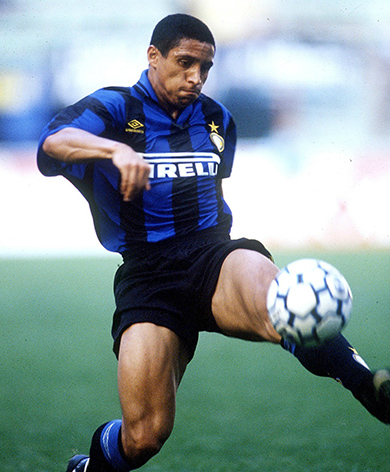
A Brief Stop in Italy
n 1995, Roberto Carlos joined Inter Milan, but his attacking instincts clashed with Serie A’s defensive rigidity. After just one season, he sought a new challenge — a move that would change his life forever.
Glory at Real Madrid
Roberto Carlos joined Real Madrid in 1996 after a single season at Inter Milan. Signed for around $6 million, he was initially seen as a gamble due to his attacking instincts, but Madrid quickly realized they had acquired a revolutionary left-back.
His debut season already showcased his trademark blend of blistering pace, relentless stamina, and thunderous shooting power.

Roberto Carlos was central to the Galácticos project, playing alongside Zidane, Figo, Ronaldo, and Beckham. His attacking flair complemented Madrid’s star-studded midfield and forward line, while his defensive work rate balanced the team’s expansive style.
He was not just a supporting player — he was a symbol of Madrid’s dominance in the late 1990s and early 2000s.


🏆 Titles and Achievements
During his time in Madrid, Roberto Carlos played 584 matches in all competitions, scoring 71 goals
His trophy haul was immense:
• 3 UEFA Champions League titles (1998, 2000, 2002)
• 4 La Liga titles (1997, 2001, 2003, 2007)
• 2 Intercontinental Cups (1998, 2002)
• 3 Spanish Super Cups (1997, 2001, 2003)
Roberto Carlos' free kicks and long-range shots became legendary, often clocking speeds above 130 km/h.

His fitness and consistency were remarkable — he rarely missed matches and was a fixture in Madrid’s starting XI for over a decade.
He was described as “the most offensive-minded left-back in the history of the game”, and his influence shaped generations of full-backs who followed.
Roberto Carlos left Madrid in 2007 and embarked on a diverse and globe‑spanning career, playing in Turkey, Brazil, Russia, and even India, before moving into coaching and ambassadorial roles.
Fenerbahçe (2007–2009)
Roberto Carlos joined Fenerbahçe in the Turkish Süper Lig, where he quickly became a fan favorite. He played 65 matches and scored 6 goals, bringing his trademark attacking runs and free kicks to Istanbul.
He helped the club reach the Champions League quarterfinals in 2008, their best run in years, and added valuable experience to a squad eager to compete internationally.

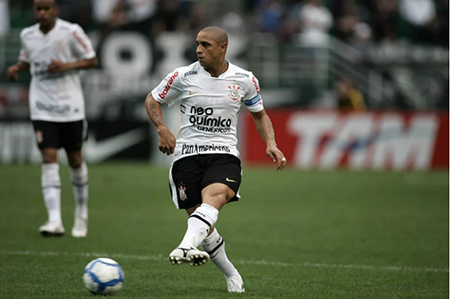
Corinthians (2010–2011)
Returning home, Roberto Carlos signed with Corinthians, where he played 35 matches and scored once. Despite his age, he remained a regular starter, partnering with Ronaldo in what was dubbed the “old guard” of Brazilian football. His time ended abruptly after a Copa Libertadores defeat, but he left having contributed leadership and professionalism.
Anzhi Makhachkala (2011–2012)
In one of the most surprising moves of his career, Roberto Carlos joined Anzhi Makhachkala in Russia. He played 25 matches and scored 4 goals, but more importantly, he became captain and mentor to younger players. His arrival was part of Anzhi’s ambitious project, which later attracted stars like Samuel Eto’o. Roberto Carlos transitioned into a coaching role in 2012, marking the start of his managerial career.

Roberto Carlos had a brief stint in the Indian Super League, playing 3 matches and serving as player‑coach for Delhi Dynamos. His presence boosted the league’s profile, and he helped attract international attention to Indian football.

International Stardom
With 125 caps for Brazil, Roberto Carlos featured in three World Cups, lifting the trophy in 2002. His marauding runs down the left flank embodied Brazil’s attacking philosophy, and he remains one of the most influential full-backs in international football history.


Legacy of a Pioneer
Roberto Carlos redefined the role of the left-back, proving it could be both defensive anchor and attacking weapon. From Garça’s dusty pitches to the grandeur of the Santiago Bernabéu, his story is one of resilience, brilliance, and reinvention.

The smile of Legends
Source: Redaction Ballocentre.com
Images: GETTY, Carlinhos Guabiraba's Facebook, Anzhi Makhachkala